By Mike Ryan
Characteristics
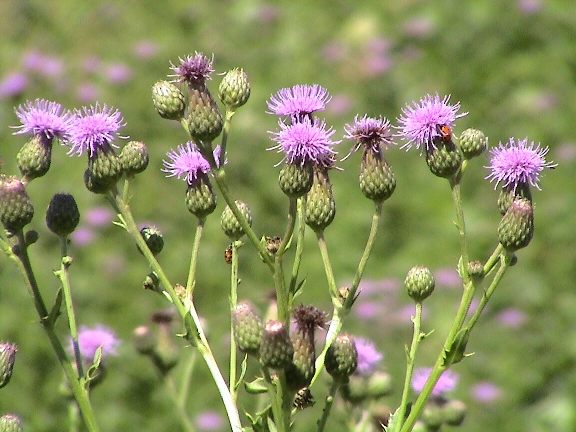
Canadian thistle, Cirsium arvense, is an aggressive, noxious perennial weed. Infestations usually start on disturbed ground.
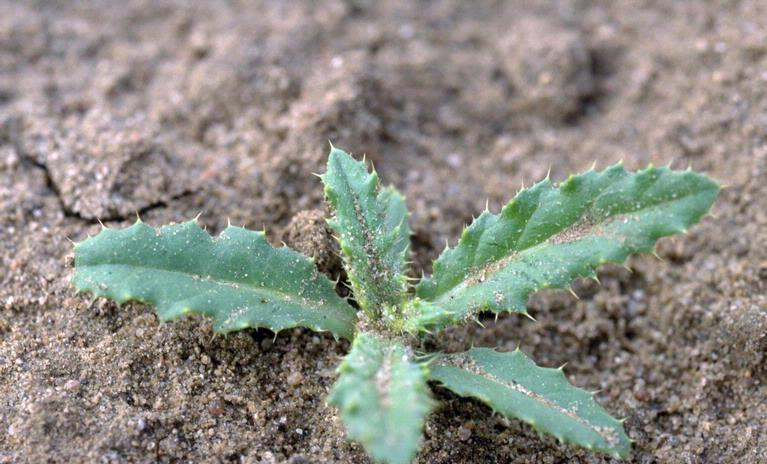
Canadian thistle develops from seed or its root system. Horizontal roots may extend 15 feet or more and vertical roots may grow up to 15 feet deep. The plant can grow to 4 feet tall.
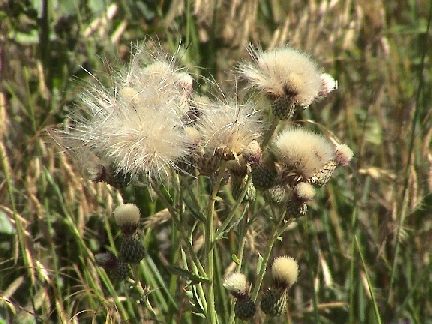
Canadian thistle begins to flower in late spring to early summer. Seeds develop in late summer, and are carried away by the wind to surrounding areas where there is disturbed soil. Seeds are viable for up to 20 years.

Control of Canadian Thistle
Canadian Thistle is a Perennial, which means that it comes back each spring, re-growing from the roots. In addition, it produces seeds that produce new plants.
Pulling or chopping the plant can be effective, but needs to be re-done as new shoots emerge. The idea here is to force the plant to use up the energy stored in the roots until the plant has no energy to re-grow, and dies. For the same reason, periodic Mowing can also be effective.
Another effective way to treat Canadian Thistle is with 2,4-D herbicide. This herbicide kills broadleaf plants, but not grass, and will kill the stem and the root of Canadian Thistle within a few weeks of application. Because this does not kill grass, any grass that is growing near the Thistle will now be able to move into the space occupied by the thistle. Most home improvement centers and gardening stores carry both a concentrate and a ready to use solution of 2,4-D. Amazon also carries 2,4-D.
My preference for treating this invasive weed is to use a solution of 2,4-D, diluted according to the label, mixed with Lazer blue dye. The blue dye is helpful in reminding me which plants I have already treated, and the color lasts several weeks. Re-application may be required.
 Homestead Hills Civic Association